Can you help Identify this Spitfire Shot down in North Africa - a User Asks
2025-10-11
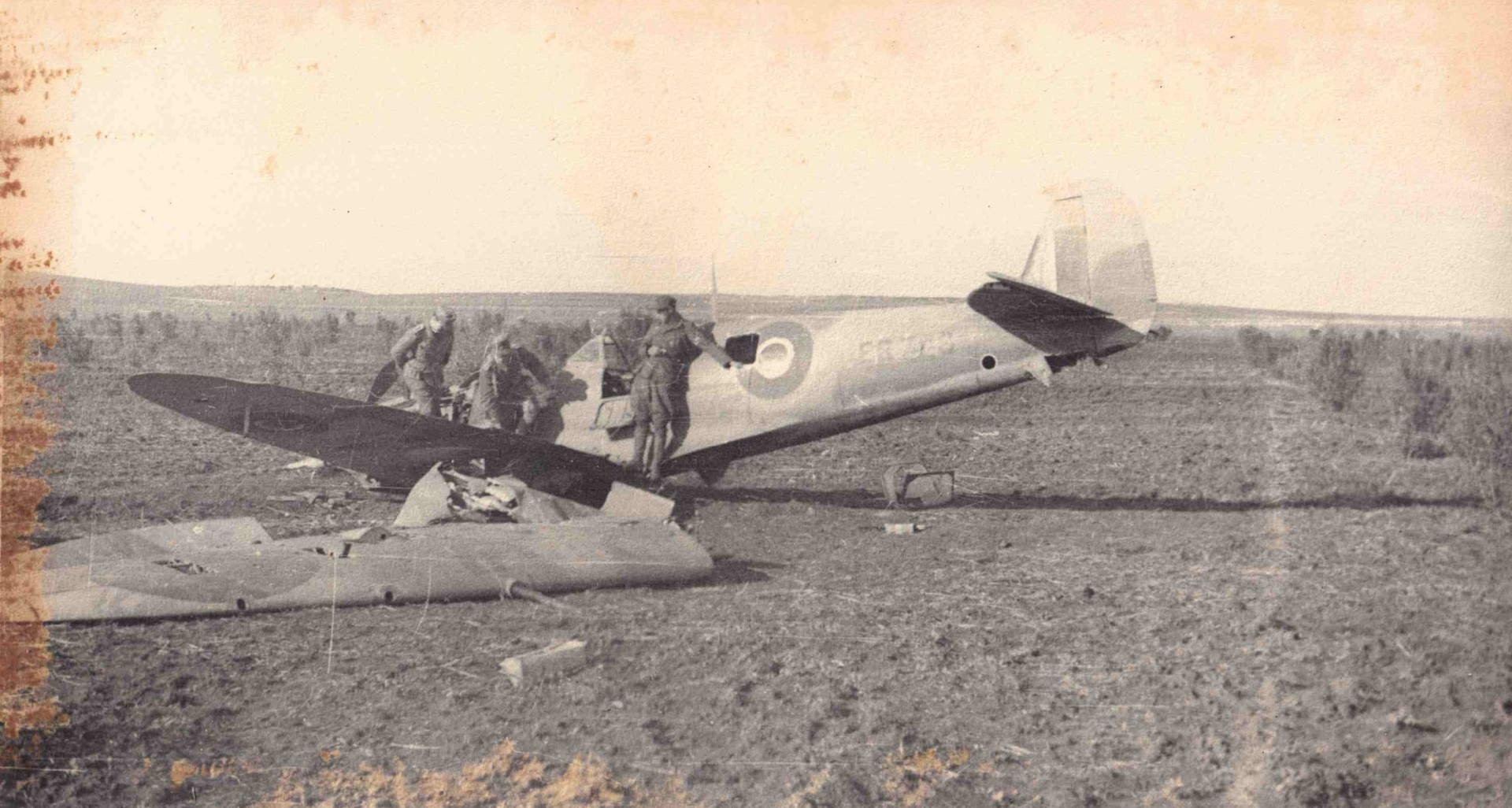
In the image, one can see a mostly intact Spitfire with German troops examining it. This photo has a serial number only partly identifiable, so Francois kindly contacted us for our take on identifying it.
One of our editors, Kevin, got to work on it as he enjoys a good Spitfire mystery. One can see in the image a partial serial number with 100% confidence on the number 7, 80% confidence on the last digit being a 6 (I did not discount the 8 immediately) and low confidence on the middle digit, which Francois gleaned through steady stare to be a 2. It’s the middle digit that created the mystery along with the fact that there was no squadron code on the aircraft.
So with that information we went to work on this image, and it kind of went like this;
1. Kevin first assessed the overall image as set by water, with German troops inspecting it as we’ve seen in similar imagery, and a mostly intact aircraft, suggesting the pilot may have survived the crash? The lack of squadron marking was also noted.
2. I ran the photo into photoshop to play with contrast and magnification to help solidify last digit was a 6 and not an 8, giving 6 the benefit of the doubt.
3. Kevin, using our database, suggested a process of elimination checking each ER7?6 and ER7?8 serial against operational records in our Spitfire database, whose origins come from Andrew Pentland’s website with permission ( some years ago).
4. Both Francois and Kevin agreed on the eliminated aircraft, owing to geography and/or loss conditions, such as a wheels down accident at an allied airfield vs a loss in combat. You can use our search bar at the top navigation of the site under the “Spitfires” tab to do this yourself, entering serials such as ER746, ER723, etc. into search.
5. After looking at the results, a "fair" consensus was achieved on three or four possible aircraft, including a possible pilot identification, more on that later. While it’s not 100% confirmed, the ER726 was considered likely, and, we’ve added the image to our database record for ER726 here. It had an initial brief note there confirming east Africa ops with a code of FTR (Failed to Return). Is this the aircraft in the image above?
6. There was already a serial (ER726) listed in our records for F/O Large from a separate KIA database given to us by renowned Canadian historian and author Mr. Halliday. Other users have since added more serials /dates for him from the ORBs. This would be reputable information as part of Mr. Halliday's records, and the date lines up with entry for ER726 as FTR. Additionally, the National Archives UK has the following:
Reference: AIR 81/20636
Flying Officer W S Large (RCAF): missing believed killed; Spitfire ER726, 81 Squadron, aircraft failed to return from an operational flight, enemy action, Bone, Algeria, 1 January 1943
7. Per the link (see point 8 below) it is noted this pilot did previously get shot down behind enemy lines and was able to evade back in late (Nov) 1942. Given the state of the aircraft, this image would fit with an evasion or at least the survival of the pilot before taken as POW, but F/O Large's evasion was two months earlier than his KIA date, and if I recall, he had baled out on that occasion. So then ER723 becomes a candidate (Sorensen POW) but may not fit either based on first hand account of crashing inverted and dug in (more than likely breaking the R/T antennae off). ER778 was also a candidate (see below) but that is also questionable.
So the question remains, was F/O Large flying the aircraft in the photo, if it is indeed ER726? Or was his loss a separate incident around the same time. One other source (see #10 below) online indicate he was shot down by a Bf109 over the sea, but is that even accurate? We know one thing, he did indeed fly ER726 with 81 squadron and if the image above does depict ER726 then it is a match to 1-1-1943. We will call that a probable.
8. Regarding F/O Large, further search on William S Large (our listing), Canadian RCAF pilot, came up with the Canadian Veterans Affairs website which has collected some extra information. You can read it here.
9. An interesting side-note on F/O Large that may shed detail in general on this campaign by 81 and 242 squadron, one of the clippings refers to this pilot having written a book about his prior months of combat operations in the Tunisian campaign. A book which had entries just before his last sweep. It would be interesting to find it, as one of the press clippings indicates he was previously shot down, in November 1942. See his page on our site for "The Diary of a Canadian Fighter Pilot". It may exist in select libraries and archives.
10. So back to the image, a separate site online (key.aero) alluded to above, has a 2012 discussion thread with a different image of this aircraft taken at the same time moments apart. Users can squint at the serial # and see if it differs. This is where notes on that web page also lead some other theories. So we can't be definitive on the image or circumstances but more than one source seems to suggest F/O Large was killed in ER726. This image is a possible match, so we are going with it as "probable" for ER726. Care to join in and further the research? I'll add any comments below ...
11. Here's an addition from one of our users, Justin. "ER726 ER723 If you look at Air27-1428-40 & 1428-41 of 232 squadron the 11-04-43 you can see P/O Sorensen's was flying ER723 on the 11-04-43 missing believe killed. Maybe I'm wrong but the 6 looks like a 3 to me. The Germans may of turned the Spitfire back over from inverted". What do you think?
In reading some of the ORB summaries for 81 SQN for late 42 and early 43, one finds an almost impossible environment to operate in. Muddy, wet and cold fields with rough living conditions were hard on aircraft and people. Parts in short supply meant scrounging and salvage. Constant bombing (both sides) with little protection. Being attacked by bf109s while taking off or landing, and constant air battle - lead to high mortality rates. A forced crash landing in enemy territory was no guarantee of survival due to the harsh landscape and distance to medical help. Some did evade with local help. Constant scratching due to fleas, rainy nights in tents in wet sleeping bags are noted. An officers move to town in an old Hotel close anti-aircraft batteries only meant continued loss of sleep from the nightly bombing raids. Combined with squadron losses and the necessity to alter doctrine to adapt and fight on must have brought pilots and ground crew to their very limits. For those that did survive, it must have hardened them for the Italian and Sicilian campaigns to come.
The siege of Malta and the air battles there have become well recognized over the years, and I hope the Tunisian and other North African action becomes prominent in significance as well - these pilots took the full force of aerial battle in dire circumstances.
We gladly receive any requests to help with pilot or aircraft information, and we also encourage any user to take a first step by using the UK National Archives database to research a pilot or air fact as the ORBs (operational record books) are available for free if a user registers there. We are happy to show you how also. Results aren't always definitive, but usually result in at least additional information as it is in this case.
Do you enjoy these types of stories, new content, and, research? If you do, please let us know though the contact us link at the bottom.
Best
Kurt