
News & Articles
Maintenance Complete Oct 2026
2026-10-27
 You may have noticed we were working on the site the last few days. We took the site out of service to do some upgrades and that went well.
The allspitfirepilots.org web-site is custom coded on an advanced web platform and that's what allows us to create the relationships you see here between pilot and Spitfires flown and vice versa. With your input of course, which is why there are over 4,500 pilot biographies on the site today.
So now we're back up -- and -- you can get back to adding your pilots, log book entries, comments, and Spitfire images. We do get an email whenever you, the logged in user, adds an image, a comment, a pilot, or a log book entry. Kevin, our chief editor -- is on hand to solve your mysteries by assisting you with National Archive searches, and, I am here to handle your requests and emails in general -- and so do be in touch. To our regulars, thanks for being patient during our upgrade. As always, let us know through the contact us if you have a feature request or you have a suggestion or a fix you'd like to see.
Kurt read more ...
95 years ago the Supermarine S.6B broke the world speed record at 407 miles an hour
2026-09-29
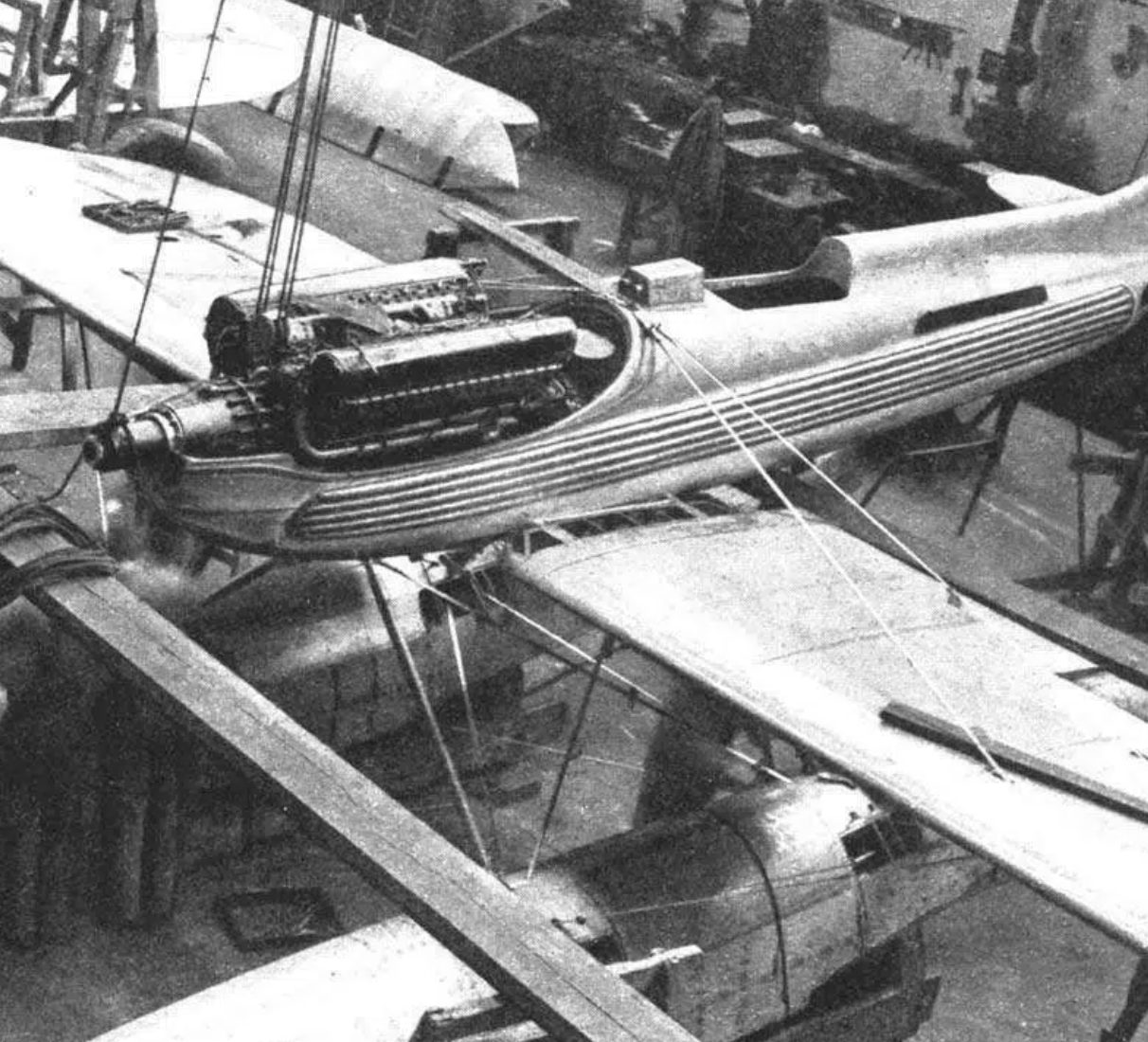 On September 29, 1931, Flight Lieutenant George Stainforth made aviation history by flying the Supermarine S.6B (precursor to the Spitfire) to a world airspeed record of 407.5 mph, becoming the first person to break the 400 mph barrier. The achievement came just weeks after the aircraft secured victory in the Schneider Trophy and showcased the cutting-edge design work of R.J. Mitchell and the power of the Rolls-Royce R engine. The record cemented the S.6B's place among the most significant racing aircraft ever built.
R.J. Mitchell would not live to see the evolution of this aircraft, his Supermarine Spitfire, fly in WWII. He passed away in 1937, but his legacy can't be understated. Many talented engineers carried on his work. Of note, the aeronautical engineer he assigned to develop the famous Spitfire wing was a Canadian.
Canadian aerodynamicist Beverley Shenstone designed the iconic elliptical wing of the Supermarine Spitfire.
Wing Design Details;
• The Aerodynamicist: Beverley Shenstone served as the chief aerodynamicist under R.J. Mitchell at Vickers-Supermarine.
• The Shape: They chose a thin, double-elliptical planform to minimize induced drag and allow for high speeds.
• The Challenge: The ultra-thin profile had to be strong enough while still housing retractable landing ... read more ...
Battle of Britain Memorial Needs Your Help!
2026-09-13
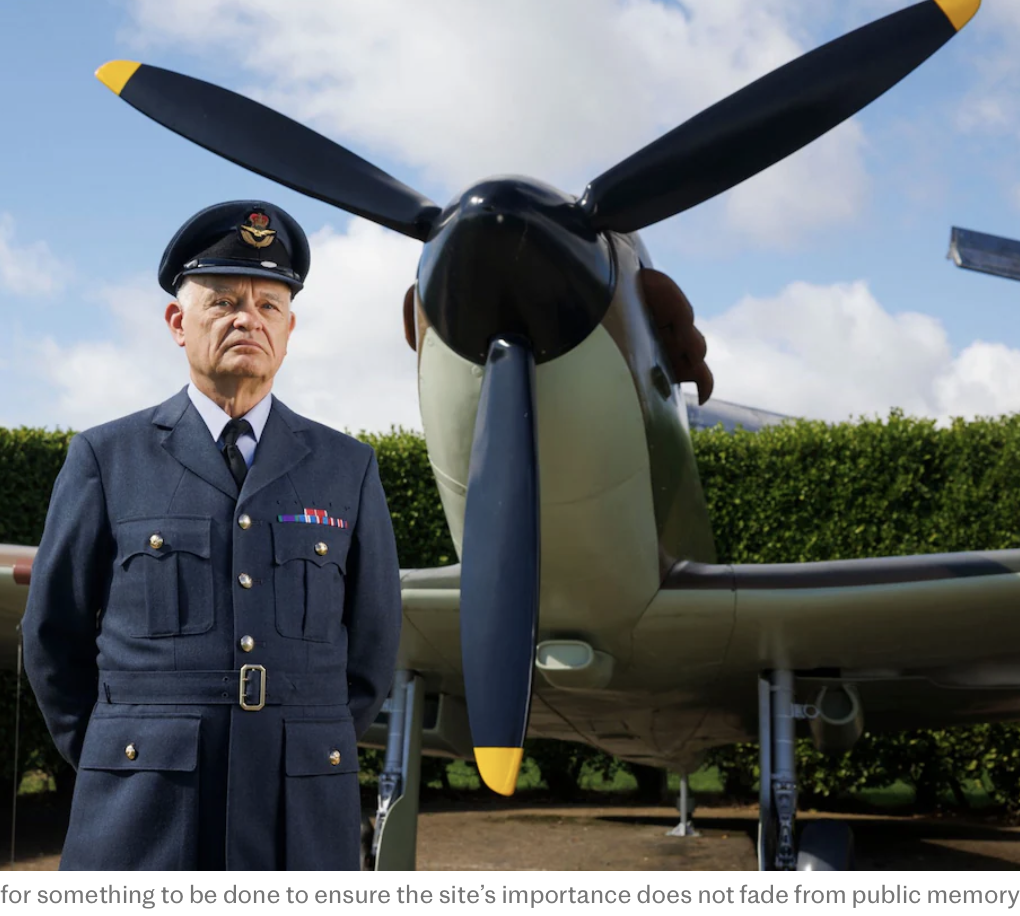 As you can read in telegraph article linked below, the Battle of Britain Memorial at Capel Le Ferne (Dover) is at risk of closure due to lack of support, not from visitors, but from a lack of UK museum funding that other tier 1 installations like this actually get. Because it is a "memorial" it does not qualify for these national museum grants, which is a shame.
UPDATE: The Battle of Britain Memorial at Capel-le-Ferne in Kent has raised over £10,000 from the public following a Telegraph appeal highlighting its severe funding shortfall. People are responding and likely conversations are ongoing in other circles. Good luck Capel Le Ferne memorial!
Our chief editor Kevin Charles, and I -- visited Capel Le Ferne on Sept 15, 2019 -- on Battle of Britain day, and we were so lucky to watch the Spitfire flypast, service, and full tour of the "memorial" which I would actually say is as as good if not better than many a museum in that they have an interactive full 3D animated recreation of a Battle of Britain airfield and battle at full sound.
Such an important memorial reminding us today of the struggle against fascism, in this ... read more ...
Happy 90th Birthday, Spitfire!
2026-07-02
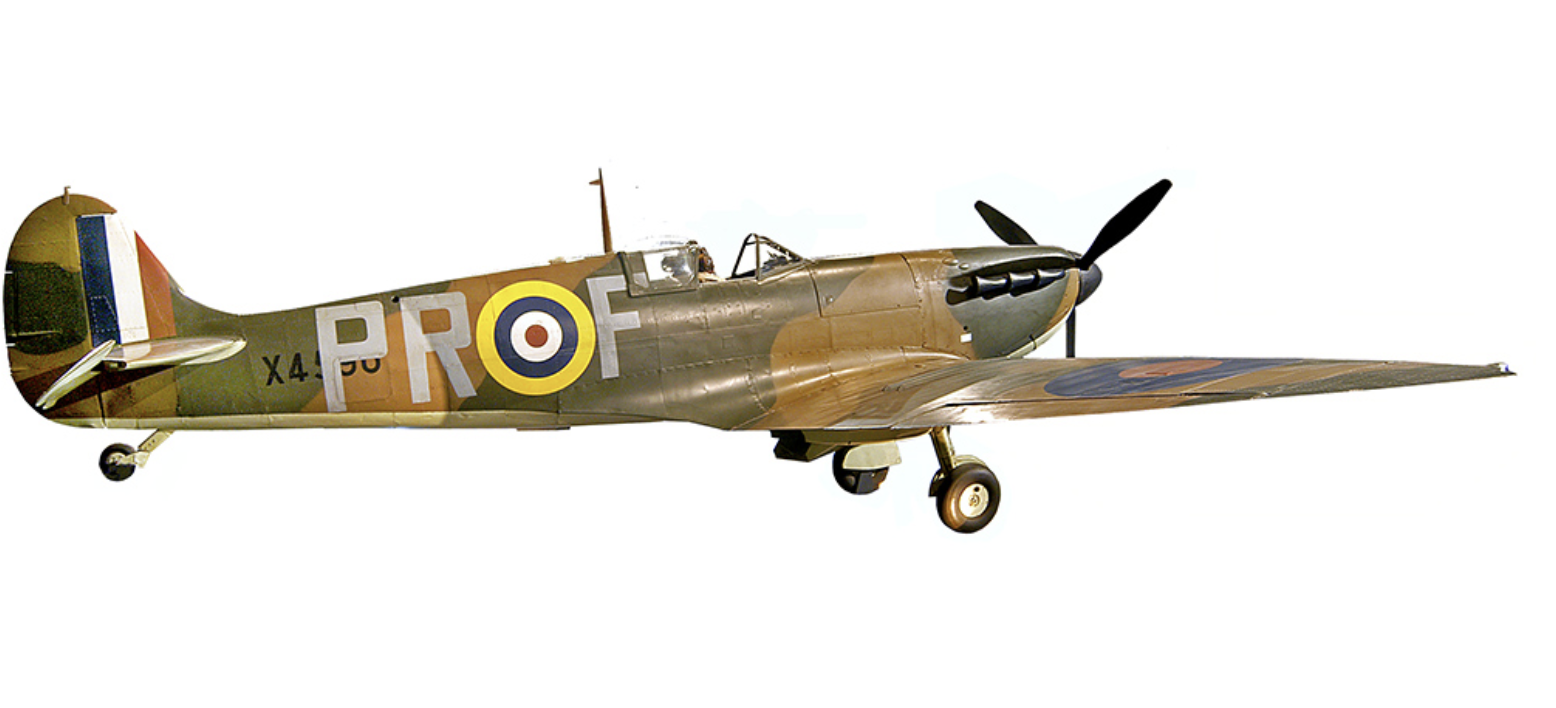 This year marks the 90th anniversary of the Supermarine Spitfire's first flight, which took place on 5 March 1936 at Eastleigh Aerodrome in Southampton. Test pilot Joseph 'Mutt' Summers famously landed after the prototype's eight-minute maiden flight and remarked, "Don't change a thing." Those words would prove prophetic as the Spitfire went on to become one of history's most iconic aircraft (and of course it did improve significantly throughout the war as variants had to keep up, but the point is, pilots loved it!).
To commemorate this remarkable milestone, a number of special events are taking place across the UK during the summer of 2026:
* Southampton – The Birthplace of the Spitfire: Throughout the year, Southampton is hosting exhibitions, guided walks, museum displays, commemorative plaques, and flypasts celebrating the aircraft's origins.
* Shuttleworth Summer Air Show – 25 July 2026: A truly unique event aiming to gather **one example of every airworthy Spitfire mark currently flying in the UK**, alongside special displays honouring the aircraft's designers, test pilots, and wartime service.
* Spitfire 90 Commemorative Tour: A restored two-seat Spitfire painted as prototype **K5054** is undertaking a nine-leg circumnavigation of Great Britain, accompanied on many flights by Royal Air ... read more ...
David Garrett's work on 154/232 Squadron
2026-03-12
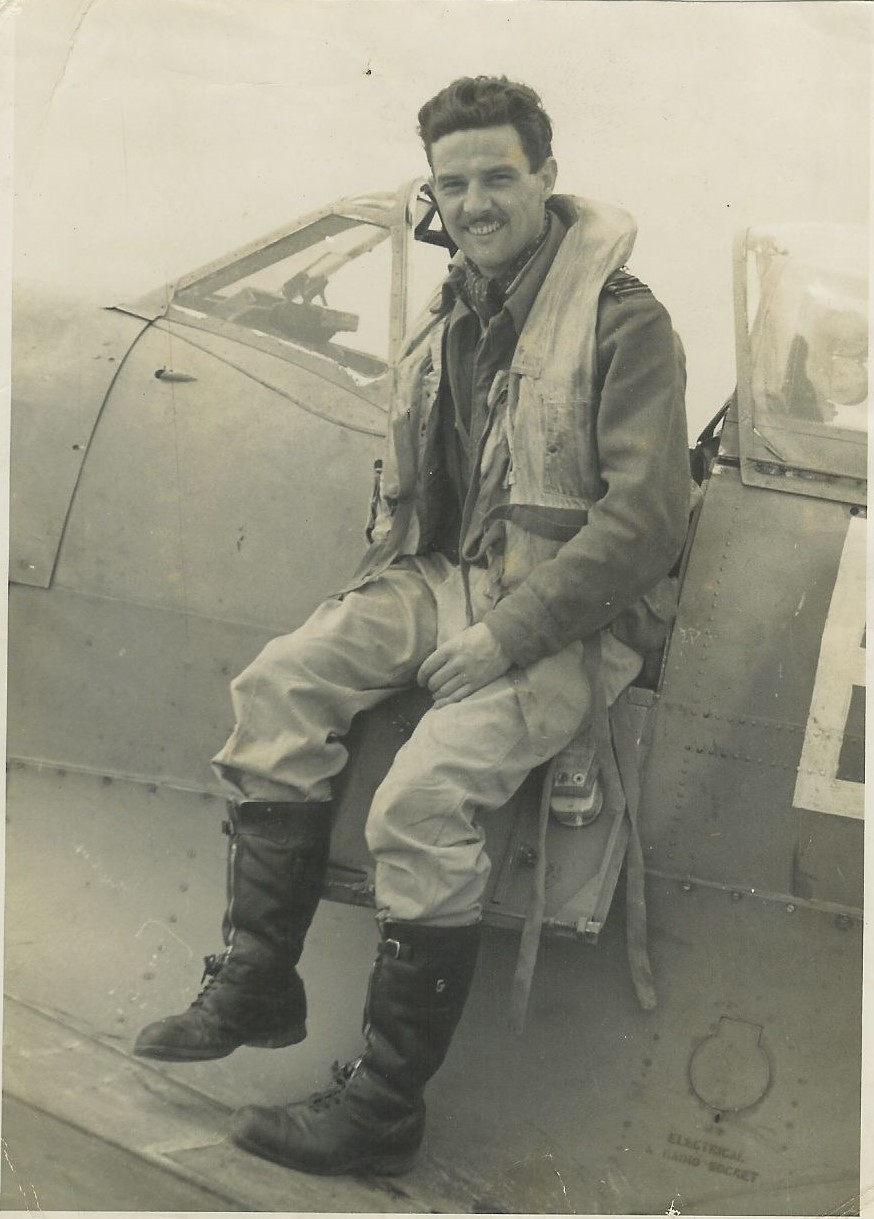 If you've been watching the pilot additions over the last few months, you may have noticed lots of pilots from 154 SQN being added to the site, complete with squadron dates, flight details (our mini-log book entries), bio, and images. If you want to know who has been submitting these pilots (232 SQN as well) then read on. David has been a great help to the site, encouraging us to add some new features, and, taking great care in detailing his entries. I asked David several questions starting with "tell us about yourself" and "why you are adding all these pilots" and questions like "what are your most interesting finds?". You will enjoy this read, including David's own adventures.
 UPDATE: If you click the 154 Squadron link above, you will now see a map of the squadron's movement over time, including UK, Algeria, Tunisia, Malta, Italy, Israel, Syria, and France. You can animate their movements on that page. It's draft, in that some detachment details are missing and dates are approximate.
"I am David Garrett, I live in Sunbury-on-Thames near Hampton Court, west London. I am 80 years of age (big celebration a couple of weeks ago!). I ... read more ...
Adding / Editing Unit (Squadron) info and Dates on Pilot Page
2026-03-06
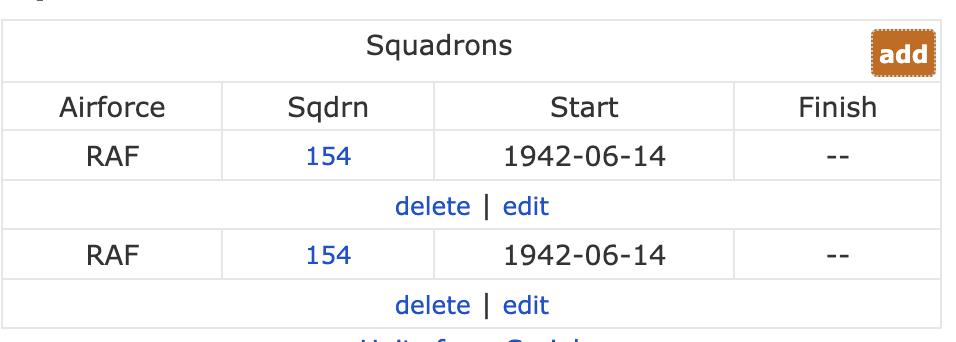 Up until now, a user would only be able to add squadron information (unit #, airforce, start, finish) to a pilot page but not edit or correct it.
Users often add squadron / unit information but at the time don't know a start date or finish date for the time that pilot was in a squadron/unit. Users want to be able to simply add a squadron number without dates. Dates can come later.
So now, there are two ways to make changes or corrections for our two different cases on the squadron section of the pilot page;
1. If you added that squadron information (logged in) to begin with, you have several days to edit that line (SQN, Airforce, dates) or delete it.
2. Where a date is missing, logged in users can click "add date(s)" to add this extra information.
If you are only adding a date, the other existing information (unit #/airforce) will be greyed out. If these options don't work for you, and, you have to make a correction that isn't covered by either of the above, just use the contact us and we will help you out.
Kurt read more ...
PRU Pilots Revisited
2026-01-19
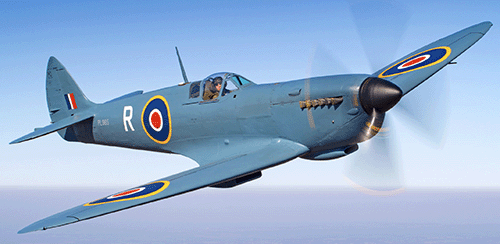 Time to time, we get a strong interest in PRU (Photo Recon Unit) pilots, whose missions generally involved some extremely dangerous low level flights over enemy targets, with no weapons, a lot of slipping and sliding the aircraft to avoid obstacles, along with considerable sweat and determination. They also flew at very high altitudes such as over industrial plants deep inside enemy territory. We have some fascinating stories such as from the son of pilot John Bendixson, and just now, another user who knew a PRU pilot and now wants to find as much detail as possible.
So to start this research, and we are due for a refresher, I am going to list all our PRU pilots (there may be more), and we will fill in this article further on the PRU pilot we are currently assisting on the research. But for an excellent read, check out the exploits of John Bendixson via the comments and sample PRU photos (his father took) that his son added to his father's page.
Also, this is a query we just received, for F/L Maurice Hicks. "I came across this site whilst searching for a former PR spitfire pilot ... read more ...
Squadron Movement MAPPING feature with Animations!
2025-11-13
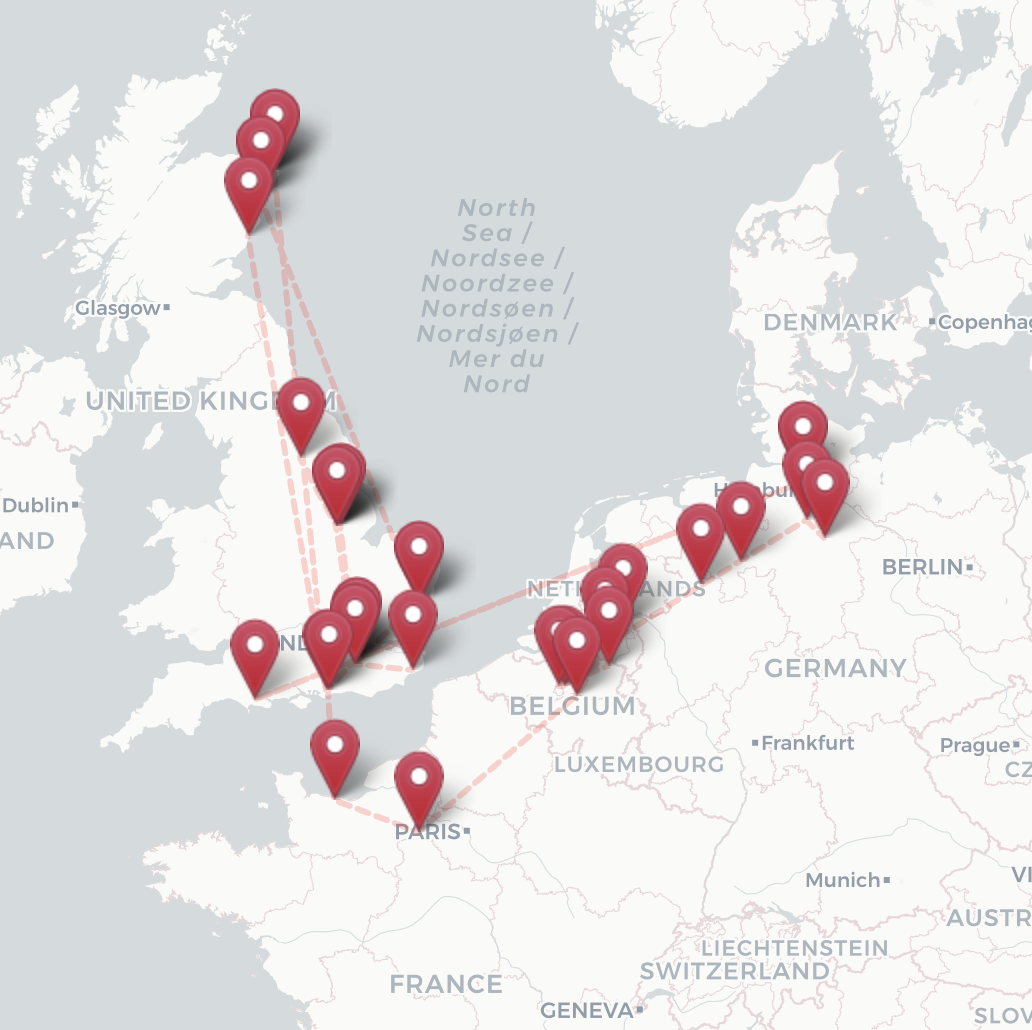 We are very excited to announce a new feature on allspitfirepilots.org. If you have a look at the following sample pages for RAF; 601 RAF, 92 RAF, 310 RAF, and for RCAF; 411 RCAF, 442 RCAF, and 416 RCAF you will see some examples of the new squadron pages we are creating.
UPDATE: All RCAF Squadrons ( that flew the Spitfire in combat ) have now been mapped. That would be 400, 401, 402, 403, 411, 412, 414, 416, 417, 421, 430, 441, 442, 443.
For any squadrons for which we collect this squadron movement data and create a map, the squadron page now starts with a large map showing where the squadron moved over time, and below it, all the pilots we have on the site for that squadron, roughly sorted by date. The map allows you to click through to see aerial views of these airfields as they are today!
Kevin Charles, our chief editor has had a crack at the RAF squadrons, in particular because his father served in 601. Kurt, meanwhile, wrote the mapping software along with features to allow (somewhat) easier imports of location, dates, and, squadron information -- ... read more ...
Funding Season - Hosting Cost Donations Drive
2025-11-01
 Well it's that time of year we look at hosting costs and how to cover them. As volunteers who host the site at our cost and offer all the information, reserch, new features and user support, our only ask is that if you have found the site helpful, that you consider donating once or even annually. We want to keep developing new features, and, some new ones are almost ready to announce (announced now, see our maps).
Our site is well used globally, and, we enable research by digging deep into the military records, including the ORBs. Users who add pilot data such as aircraft flown help us relate pilots to aircraft flown, and in turn to other pilots who flew the same aircraft in the same squadron (or later).
Now, we've come up with a very interesting set of maps that show squadron movement, with animations. What discoveries will that feature enable?
We will unveil that shortly, but as volunteers and administrators of this site -- we are here for your requests, and, provide development and support. There are no fees paid for development - we are the developers. We use the laravel software framework to create relationships ... read more ...
Can you help Identify this Spitfire Shot down in North Africa - a User Asks
2025-10-11
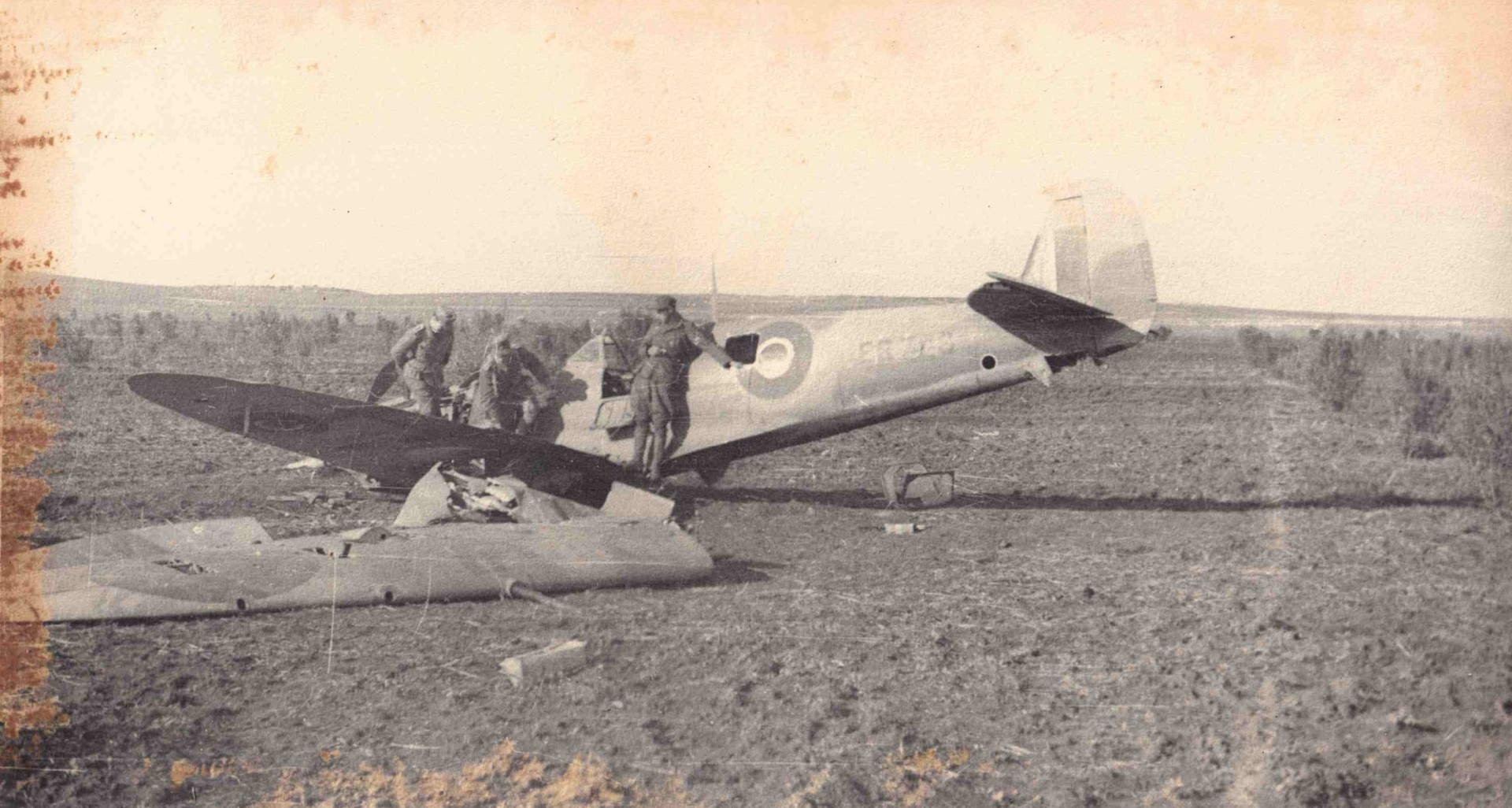 Recently, a user from France came to us with an aircraft mystery to help solve based on a photo he acquired in a WWII era photo album of German origin. Purchased recently, the album contained German fighter aircraft and airfields from the North African campaign, but it did have one image of a downed Spitfire.
In the image, one can see a mostly intact Spitfire with German troops examining it. This photo has a serial number only partly identifiable, so Francois kindly contacted us for our take on identifying it.
One of our editors, Kevin, got to work on it as he enjoys a good Spitfire mystery. One can see in the image a partial serial number with 100% confidence on the number 7, 80% confidence on the last digit being a 6 (I did not discount the 8 immediately) and low confidence on the middle digit, which Francois gleaned through steady stare to be a 2. It’s the middle digit that created the mystery along with the fact that there was no squadron code on the aircraft.
So with that information we went to work on this image, and it kind of went like this;
1. Kevin first assessed ... read more ...